

Haishun Machinery Co. , Ltd. is located in economy, traffic convenient Taizhou (The sprayer capital of China), Zhejiang, China. we specialize in the research and development, producing and manufacturing of power sprayer, plunger pump, knapsack power sprayer and pressure washing machine.




Why Choose Us
Rich Experience
Our company established in 2005, and has nearly 20 years experience in manufacturing power sprayers.We possess a high quality scientific research staffs already and a set of perfect quality certification systems.
Reliable Quality
In order to guarantee and offer the high quality and suitable price products and service continually, we insist on making 5% sale income investment in research and development field.
Global Shipping
The products sell well in the domestic market, and find a good sale in more than 30 countries and regions, such as Southeast Asia, The middle-east, Africa, Europe and America etc., we receive good evaluation from the users.
Gasoline engines are relatively lightweight, which makes the car more flexible and easier to control. This lightness also helps improve fuel efficiency and reduces the overall weight of the vehicle, resulting in lower energy consumption and emissions.
The gasoline engine provides higher power output during starting and acceleration. They typically have a higher rpm range and can deliver more torque and horsepower in a shorter period of time. This allows the car to accelerate quickly and respond to emergencies.
The maintenance and upkeep of gasoline engines is relatively simple and economical. Parts for gasoline engines are more readily available and repairs and replacements are easier than for diesel engines. This also makes gasoline engines less expensive to maintain.
Gasoline engines are generally smoother and quieter than diesel engines in terms of noise and vibration. This makes the driving experience more comfortable, especially on long journeys.

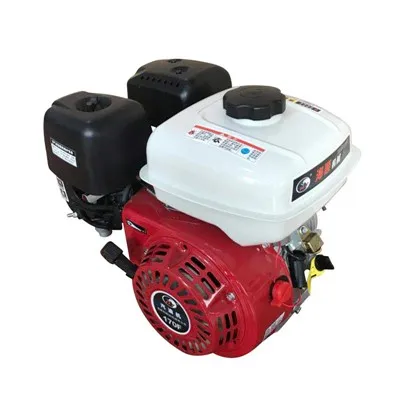
We offer the following Product specifications:
|
Single Cylinder Gasoline Engine |
|||
|
Model |
HS-168F |
Max Output (Kw) |
4 |
|
Engine Type |
Air-cooled 4 stroke OHV single cylinder |
Max Torque (N.M) |
10.6 |
|
Starting System |
Recoil hand starting |
Rated Speed (rpm) |
3600 |
|
Air Cleaner |
Semi-dry; Oil bath; Dual |
Displacement (cc) |
196 |
|
Ignition System |
Transsitor magneto |
Fuel Consumption (g/Kg.h) |
395 |
|
Working System |
Reciprocating piston engine |
Fuel Tank Capacity (L) |
3.6/4 |
|
Bore x Stroke (mm) |
68x54 |
Engine Oil Capacity (L) |
0.6 |
Types of Gasoline Engine

Four stroke cycle engine – When the cycle is completed in two revolutions of the crankshaft, it’s called four stroke cycle engine.
In four stroke cycle engines the four events suction, compression, power and exhaust take place inside the engine cylinder. They are completed in four strokes of the piston ( i.e 2 revolutions of the crank shaft). The engine has separate valves for controlling the inlet of charge and outlet of exhaust gases. The opening and closing of the valve is controlled by cams, fitted on camshaft. The camshaft is driven by crankshaft with help of suitable gears or chains. The camshaft runs at half the speed of the crankshaft.
Two stroke cycle engine – When the cycle is completed in one revolution of crankshaft, it’s called two stroke cycle engine.
When the piston moves upward it covers two of the ports which are the exhaust port and the transfer port, which are normally almost opposite to each other. As a result it traps the charge of air- fuel mixture drawn already into the cylinder. The further upward movement of the piston compresses the charge and uncovers the intake port. Following it fresh mixture is drawn through this port into the crankcase. Just before the end of this stroke, the mixture in the cylinder is ignited by a spark plug and thus, during this stroke both suction and compression events are completed.

Engine construction and operation
The overall structure of a gasoline engine depends almost entirely upon the intended application. Apart from the type of cycle (two- or four-stroke), the provision for mounting is the main structural difference among automotive, marine, stationary, and aviation engines.
When a clutch and transmission are used, as in automobiles, the engine is commonly of the so-called unit-power-plant type with a bell-shaped housing surrounding the flywheel and attached to the rear flange of the cylinder block integral with, or attached to, the transmission gear case. The clutch is incorporated in the flywheel of the engine. Three-point suspension is used in such engines; that is to say, projections on each side of the bell housing fit into the vehicle side-frame members, and a central tubular extension at the centre of the front end of the cylinder block attaches to the front cross member of the frame. This construction permits some flexing of the vehicle frame without stressing the basic structure of the engine.
Precautions for use of Gasoline Engine
Regular oil changes are one of the most important maintenance tasks for any engine, especially gasoline engines. Oil lubricates the moving parts of the engine, reducing friction and preventing wear and tear. Over time, oil breaks down and loses its effectiveness, so it is important to change the oil and filter according to the manufacturer's recommended schedule.
The air filter prevents dirt and debris from entering the engine's cylinders and causing damage. When the filter is dirty, your fuel consumption goes up quite a bit, and the engine's performance goes down simultaneously. Check the air filter regularly and replace it as needed.
Spark plugs ignite the fuel-air mixture in the engine, so they need to be in good condition to ensure proper combustion. Over time, spark plugs can become fouled or worn out, which can cause misfires and reduce engine performance. Check the spark plugs regularly and replace them if they seem discolored or worn out.
Certificates


FAQ
As one of the most professional gasoline engine manufacturers in China, we're featured by quality products and low price. Please rest assured to buy gasoline engine for sale here and get quotation from our factory. Contact us for customized service.
13hp Gasoline Engine, Air cooled Gasoline, Agriculture Gasoline Engine